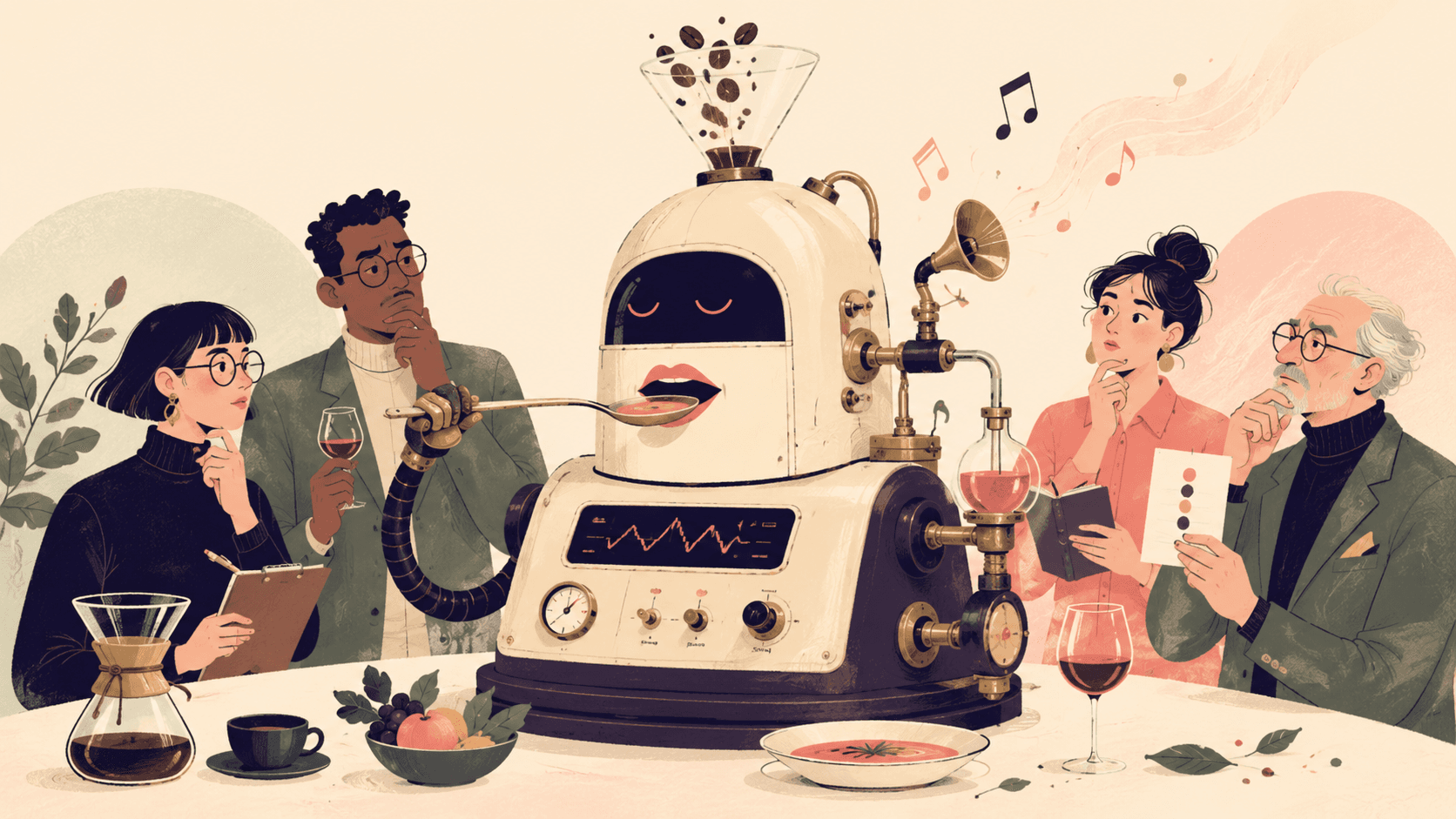
Could AI make us more creative?
The Taste-Bench Project is a research initiative focused on understanding, measuring, and improving the taste-adjacent capabilities of AI. Our ultimate goal is to teach AI to be a better creative collaborator, helping scientists, artists and other creative teams develop ideas they couldn't have developed alone.
The next frontier
Machines acquire new capabilities in waves. First they surpassed us at physical labour. Then at calculation. Then at complex tasks like coding. Soon AI will solve most well-defined technical problems.
We believe the next frontier will be “taste”: the ability to tell substantive originality from convincing-looking slop, judge what is good in a way that reflects how particular people and teams think, and help create something that is truly novel and worth caring about.
Why it matters
Better judgment under ambiguity.Current models agree too easily, praise things that don't deserve it, and confidently make poor suggestions while sounding very confident. It feels less like working with a trusted partner and more like being gaslit by someone who'd rather sound helpful than actually be helpful. Tasteful machines would recognise slop when they see it, and care more about helping you make the right choices — including choices that match your own distinctive standards, not a generic average.
Better creative collaborators.The industry is racing toward AI that acts on your behalf: booking, building, researching, deciding. But autonomy without taste is just fast and reckless. A useful collaborator knows when to propose, when to challenge, when to explore, and when to stay silent. Real creative partnership requires judgment about what matters, when the brief itself is wrong, and how to support a person's (or a team's) way of thinking rather than flattening it.
More creativity and innovation.Taste is what takes AI beyond automating tasks and generating content, towards helping people create genuinely new things. Imagine scientists discovering unexpected research directions, artists developing entirely new forms of expression, or groups of agents and humans exploring diverse possibilities together — challenging one another, then converging on ideas none of them would have reached alone. The most exciting possibility isn't replacing human creativity, but amplifying it.
What we do
We're starting by interviewing scientists, artists, entrepreneurs and other creative professionals about the role of taste in their work (see our podcast), and developing benchmarks to evaluate these capabilities in AI — including originality versus slop, distinctive judgment, and collaboration. Ultimately, we hope these insights will help us design AI systems that exercise better taste, collaborate more effectively with humans, and scale creative exploration without collapsing into generic consensus.
Contact
If any of this resonates, write to us at hello@taste-bench.com.